Practical training courses and workshops on Artificial Intelligence, software quality, Automotive SPICE, cybersecurity, product liability and regulatory requirements in modern engineering organizations.
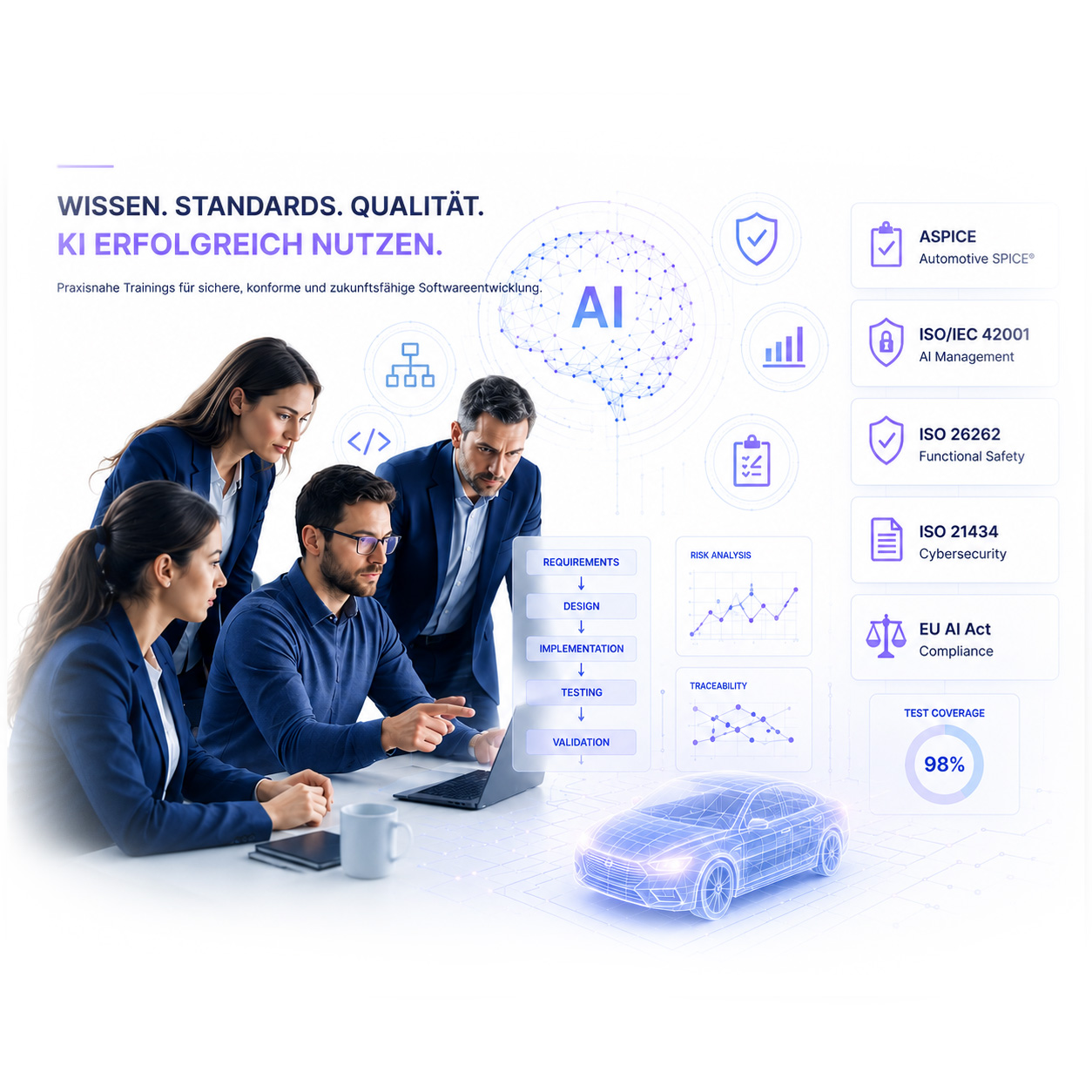
Artificial Intelligence is changing software development, testing, quality management and technical documentation. At the same time, regulatory requirements for traceability, risk assessment, product liability, cybersecurity and process compliance are increasing.
DiNC-POSiTiVE provides practical training courses for companies that do not only want to understand AI in theory, but want to know how AI can be used safely, transparently and professionally in technical development and quality processes.
The training courses combine more than 20 years of industrial experience, software and electronics expert witness competence, ASPICE experience, embedded systems, automotive, e-mobility and modern AI applications into a practice-oriented training portfolio for technical experts and decision makers.
The following training courses can be delivered as in-house training, online seminars, executive briefings or practical workshops and can be adapted to your industry, processes, tools and project environment.
Target Group: Test managers, quality managers, software testers, developers, project managers, QA leads
Duration: 1–2 days
Format: In-house workshop, online seminar or technical intensive training
Focus: This training shows how AI can support software testing and quality management in a practical way – from test case generation to review support and defect analysis.
Contents: AI-supported test case generation, requirements analysis, test case review, regression test support, defect classification, quality metrics, test reports, limitations and risks of AI in testing processes.
Benefit: Participants learn how to use AI effectively in testing without losing quality, traceability or responsibility.
Target Group: Executive management, product management, quality management, compliance, development, project management
Duration: 0.5–1 day
Format: Executive briefing, expert seminar or management workshop
Focus: The EU AI Act creates new requirements for companies developing, using or integrating AI systems into products. This training explains the key requirements in a practical and understandable way.
Contents: Risk classes, prohibited AI practices, high-risk AI, technical documentation, transparency obligations, governance, roles and responsibilities, evidence requirements, connection to product liability and quality management.
Benefit: Companies gain a clear understanding of which AI applications are critical and which organizational and technical measures should be prepared.
Target Group: ASPICE roles, project managers, quality managers, system engineers, software engineers, process owners
Duration: 1–2 days
Format: Technical workshop or in-house training
Focus: AI can accelerate development processes, but creates new questions regarding traceability, reviewability and assessment readiness. This training addresses exactly these challenges.
Contents: AI in requirements engineering, SYS/SWE processes, traceability, verification, reviews, handling of AI-generated artifacts, documentation obligations, assessment risks and ASPICE-compliant AI support.
Benefit: Participants understand how AI can be used in ASPICE-oriented projects without weakening process compliance and quality evidence.
Target Group: Developers, testers, technical departments, engineering teams, project organizations, technical writers
Duration: 0.5–1 day
Format: Hands-on workshop with exercises
Focus: Many teams already use AI without a structured approach. This training shows how technical prompts can be designed in a structured, verifiable and project-ready way.
Contents: Prompt structures, technical analysis prompts, test case prompts, review prompts, documentation support, troubleshooting, code analysis, knowledge management, limitations of generative AI and safe usage in corporate environments.
Benefit: Teams learn how to use AI efficiently and in a controlled way in their daily work – with better results and reduced risk.
Target Group: Management, security officers, quality management, development, product owners, technical leadership
Duration: 1 day
Format: Expert seminar, management workshop or awareness training
Focus: AI changes attack surfaces, decision-making processes and responsibilities. At the same time, cybersecurity, product liability and secure software development requirements are increasing.
Contents: AI risks, secure development, security by design, NIS2 relevance, software liability, attack scenarios, manipulation of AI results, protection of technical systems and responsibilities in development and operation.
Benefit: Participants understand the interface between AI, security and liability and can systematically classify related risks.
Target Group: Developers, quality managers, project managers, technical writers, auditors, process owners
Duration: 1 day
Format: Seminar or practical documentation workshop
Focus: Regulatory requirements demand traceable technical documentation. This training shows how AI can support documentation without weakening evidence, reviewability and responsibilities.
Contents: Requirements for technical documentation, traceability, review processes, audit readiness, AI support for specifications, test reports, risk analyses, decision documentation and process evidence.
Benefit: Companies learn how to create documentation more efficiently while keeping it regulatory robust.
Target Group: Developers, safety managers, quality managers, system architects, project managers in automotive environments
Duration: 1–2 days
Format: Expert training or technical workshop
Focus: In safety-related development environments, the use of AI must be considered very carefully. This training connects AI usage with safety thinking and structured evidence.
Contents: Overview of ISO 26262, safety lifecycle, HARA, ASIL, safety goals, verification and validation, tool usage, limits of AI in safety-relevant processes, review and plausibility checks of AI-generated content.
Benefit: Participants gain orientation on how AI can support safety-related projects without compromising safety argumentation and responsibility.
Target Group: Executive management, department heads, innovation managers, digitalization managers, quality leadership, IT leadership
Duration: 0.5–1 day
Format: Executive workshop or strategy session
Focus: Many companies want to introduce AI but do not know where to start. This format helps to evaluate potential, risks, processes, tools and first meaningful use cases in a structured way.
Contents: AI readiness, use case evaluation, tool landscape, governance, role model, training needs, process integration, regulatory risks, roadmap development, quick wins and next implementation steps.
Benefit: Management receives a clear decision basis for introducing AI in technical organizations.
Our training courses are based on more than 20 years of experience in automotive, embedded systems, e-mobility, software quality, test management and industrial development projects.
As a software and electronics expert witness, we also evaluate AI, software quality and technical documentation from the perspective of evidence, defect analysis, liability and technical assessment.
As an ASPICE Assessor, we connect AI topics with real development processes, traceability, verification, reviews, quality evidence and assessment readiness.
Participants receive practical methods, examples, checklists, prompt structures and procedures that can be applied directly in project work.
All training courses can be delivered as compact impulse sessions, one-day expert seminars, two-day intensive workshops or customized in-house formats.
Upon request, the content can be adapted to existing processes, standards, tool landscapes, project roles and specific company objectives. This makes the formats suitable for technical teams, management, quality organizations and compliance roles.
Dates, duration and scope are aligned with the target group, existing knowledge and company situation.
Delivery on-site, remote or hybrid – depending on your needs and participant group.
Suitable for automotive, embedded systems, industry, e-mobility, medtech, software companies and regulated development environments.
We are happy to develop a suitable training format for your company – from a compact management session to a technical intensive workshop. Feel free to share your preferred date, target group and desired focus area.
Request Training